

How to assess for college readiness when every student has a chatbot
Learning has three parts: content, process, and product. For most of history we judged all three. The industrial school kept content and dropped the other two, and now a chatbot does content for the asking. The way forward is the way back.
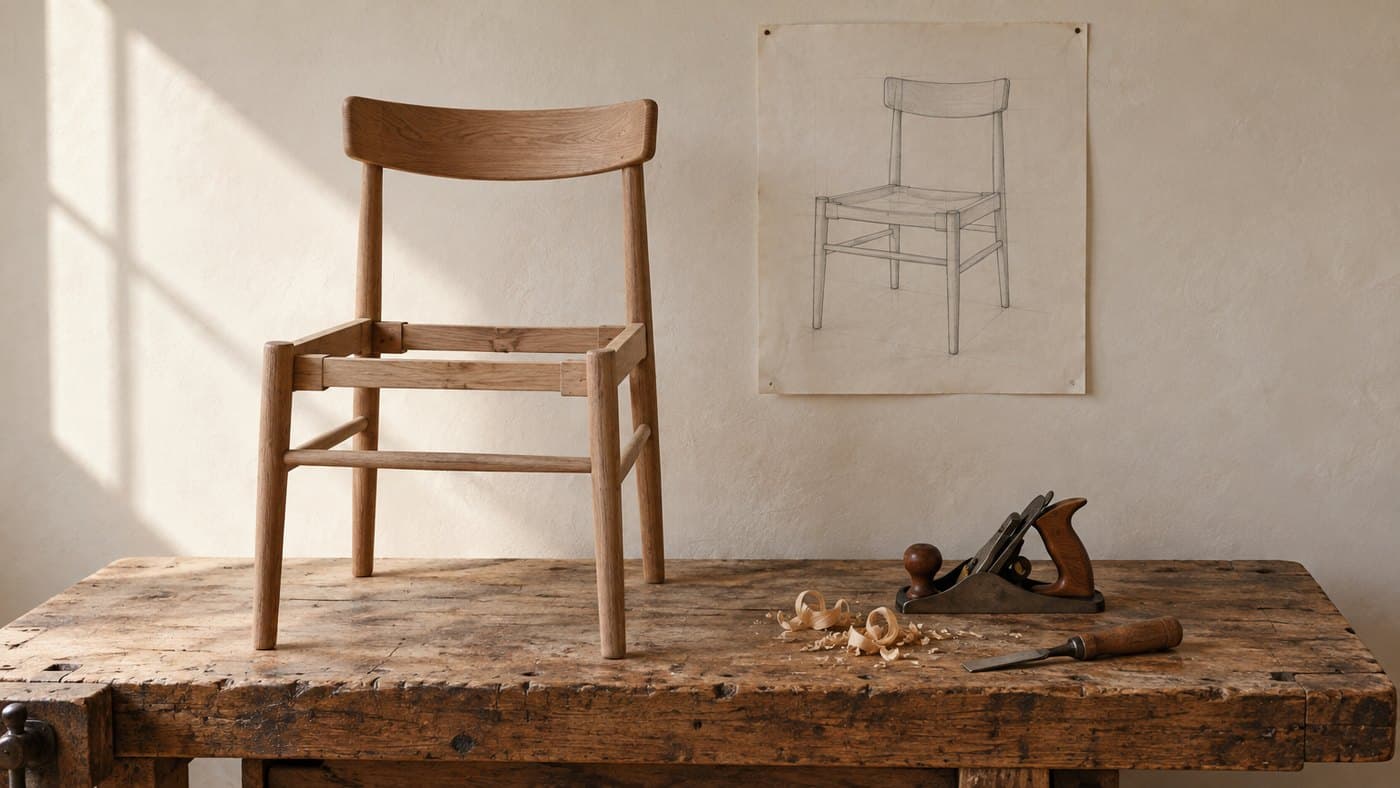
To be admitted to a guild in medieval Europe, a journeyman made one piece, alone, and set it before the masters. They looked it over, and they looked at him. If it held up, he was one of them. If not, back to the bench. One piece to show mastery, hence the name, masterpiece.
The masters were checking the three parts of any education. Content is what you have to know before you can do anything with it. Process is how you get from knowing to making. Product is what you have to show at the end. The guild judged all three: the apprentice had spent years learning the tools and the ways of the wood; the journeyman had spent years making a plank into a chair, with a master as his guide. The masterpiece was his graduation product.
They judged by watching and by asking. That is the oldest assessment we have. Socrates taught in the Athens market by asking questions, and a student showed what he knew by answering out loud. The medieval university examined by disputation, a student defending a thesis against anyone in the hall, which is why a doctorate still ends in a defense and not a test. Go back further and you reach the classroom nobody built. Watch a one-year-old learn to walk. Nobody gives her a unit on walking. She pulls up on the couch, lets go, falls, and someone she loves is watching. The falling is not in the way of the learning. The falling is the learning. And nobody tests her on it. They watch her walk.
About two hundred years ago we built the industrial high school, and it looked at content alone. Process and product stopped counting. In 1808 Johann Gottlieb Fichte told Berlin that a new national school should shape a child's will so completely that she could not choose otherwise. Prussia built that school. Horace Mann toured it and carried the model home to Massachusetts. The factory supplied the floor plan: the bell, the shift, the assembly line of age cohorts, and the standardized check at the end of the line. A factory needed hands that followed the card and a state needed citizens who followed the rule, and one school could turn out both. I have written about where that machine came from.
The new school had a lens that could see one of the three parts. Content is easy to add up in points. Process cannot be bubbled in. Product can only be compared when every product looks the same. So the school counted content, ignored process, and bet everything on the content test, until the test itself became the product.
The backlash started almost at once. In Denmark the pastor and poet N. F. S. Grundtvig called the exam-driven Latin school the school for death and asked for a school for life, where grown farm boys would learn through the living word, talk and story and song, with no examination at the end.
In 1851 Christen Kold opened the school Grundtvig had imagined, in Ryslinge, for farmers' sons: no grades, no exams, a winter of conversation. The Nordic countries still run these folk high schools, and Lene Rachel Andersen's The Nordic Secret credits the tradition behind them with the prosperous century that followed. John Dewey opened his Laboratory School in Chicago in 1896. William Heard Kilpatrick published The Project Method in 1918. In 1919 a Stuttgart factory owner asked Rudolf Steiner for a school for his workers' children, and Steiner built it for head, heart, and hands. I grew up in one of his schools, in Chicago.
Then the chatbot arrived and took the one thing the industrial high school valued most: content. Content is now free, on every phone, in every pocket. A school designed to treat children like machines now has to compete with a real machine, one built for content.
The work a chatbot cannot do is process: productive struggle through a problem with no answer key, making a thing, and standing beside it while someone who knows the field asks questions. The robots took content. Schools must now return to process. The way forward is the way back, to before the industrial high school was born.
So put the chatbot in the room and take the three parts in the guild's order. Content first, and fast. Critical thinking is bound to what you know, and a novice set loose on open inquiry without the prerequisites is overloaded, not freed. Benjamin Bloom built mastery learning on this in 1968, command of the prerequisites before you move on, and it raises achievement by about half a standard deviation, most of all for the weakest students. A short test does the job, and recalling material beats rereading it, so the quiz is part of the learning. A chatbot is a patient tutor for this part. Let her drill with it the night before, pass the check in the morning, and move on. Content is the floor. Get onto it quickly and get to the harder work of solving real-world problems.
Process is the heart of learning, and an assessment that brings it back into view will change classroom practice wherever it reaches. Problem solving, critical thinking, project-based learning, these are all words for process, and they all have one thing in common: friction, frustration, and then a small victory.
A draft that comes back marked up. A teammate who does not agree. A student who can stand the frustration long enough to reach the other side of it. The research calls it productive struggle, and the mathematics teachers wrote it into their professional standards. Project-based learning, which runs on it, has beaten traditional instruction in randomized trials, in second-grade classrooms in low-income schools and in Advanced Placement courses alike.
A chatbot is built to remove friction. In content that is a gift. In process it removes the thing being built: a crutch handed to a student who needed to lift weights.
Product is where the modern reformers pointed first, because it looked easier to assess. Ralph Tyler asked in 1949 what a school should decide first: not what to teach, but what a student should be able to do when the teaching is over. Bill Spady told districts in the 1980s to design down from the outcome. Grant Wiggins made the case for authentic assessment in 1990, real performance on worthy tasks instead of proxies, and with Jay McTighe turned the lineage into Understanding by Design. Say what the finished thing is. Say how it will be judged. Say who will see it.
McTighe is still teaching it in late 2026. At the end of October he sat down with the Cult of Pedagogy podcast and laid out the rules. Think like an assessor before you think like a teacher. Hand students the task on the first day of the unit, criteria attached. No mysteries. Then he told a small story. A ninth-grade math teacher, out of desperation, let the class choose the measure that would compute their own quarter grade, mean, median, or mode, and write a note defending the choice. One student took the mode, because he had bombed a quiz and that zero would sink a mean. Fourteen-year-olds who had never cared about central tendency wanted to understand it, because it was about them. Look at what did the work. Not the grade. The note. The explanation is the assessment, and the guild knew it.
Two repairs to Understanding by Design make the template chatbot-proof, and McTighe hands you the first himself. He calls it the scrimmage: practice under game conditions, with the coach giving feedback, the way a theater class runs a dress rehearsal, and he names skipping it as one of the mistakes he sees most. The scrimmage is process, and a chatbot cannot sit in for it. The second repair is the audience. The template allows it to be pretend, a student playing advisor to the state tourism office, and before chatbots that was a fine task. Today a chatbot writes the itinerary for a pretend office, explanation attached, in the time it takes a student to find a pencil. So the audience has to be real: human, and expert in the field. El Sistema, the Venezuelan youth orchestra movement, has run this way for fifty years: the concert is fixed, the children sit in the orchestra from the first week, and everything between is process.
Assessment researchers now name four proxies for learning: the product, the process, the performance, and the practice over time. A written product on its own is the weakest of the four, and AI compounds the weakness. The fix is not a detector. The fix is to add the performance: the piece comes with a defense, and the defense answers for the process. How she got there, what she left out, where it almost died. New York's Performance Standards Consortium has graduated students this way for decades, on tasks defended before a panel, and they persist in college at higher rates than peers who arrived with higher SATs.
This is the frame HScred was built on, which is why a project has three phases and not one. STAKE is content: the student shows she knows the ground, and her Guide, an educator at her own school, checks it. PITCH is process: a plan against the channel's public rubric, worked through at least two rounds of feedback and revision with that Guide. MINT is product: the work and its defense in a recording of ten minutes or less, scored blind by three experts against that rubric.
If you are a professor, you already live in this frame. Peer review is an expert audience by another name, and so is the dissertation defense, still running after eight hundred years. Open a channel on HScred and you will see what assessment looks like when every student has a chatbot. The students who reach you next year with HScred publications in several subjects will arrive using AI as a weight to lift, not a crutch to lean on.
The masters never asked the journeyman what he knew. They had watched him at the bench for years. They asked him to make one thing and stand beside it while they looked for themselves and asked their questions. Eleventh and twelfth graders across the country are making such pieces right now. Put them before the masters. Video can copy a student's process and carry it to experts for less than it costs to develop, test, and give a Regents exam. The industrial school buried the workshop under the factory floor. Video-driven assessment lets us dig it out and run the school as a workshop again, with process at the heart of what we judge.
Nadav Zeimer is a former NYC turnaround principal and the founder of HScred, Inc. He serves on the board of the Academic Capital Foundation.
#PassionForLearning #AcademicCapital #AuthenticLearning #ListenToTheYouth