

A Perfect Test
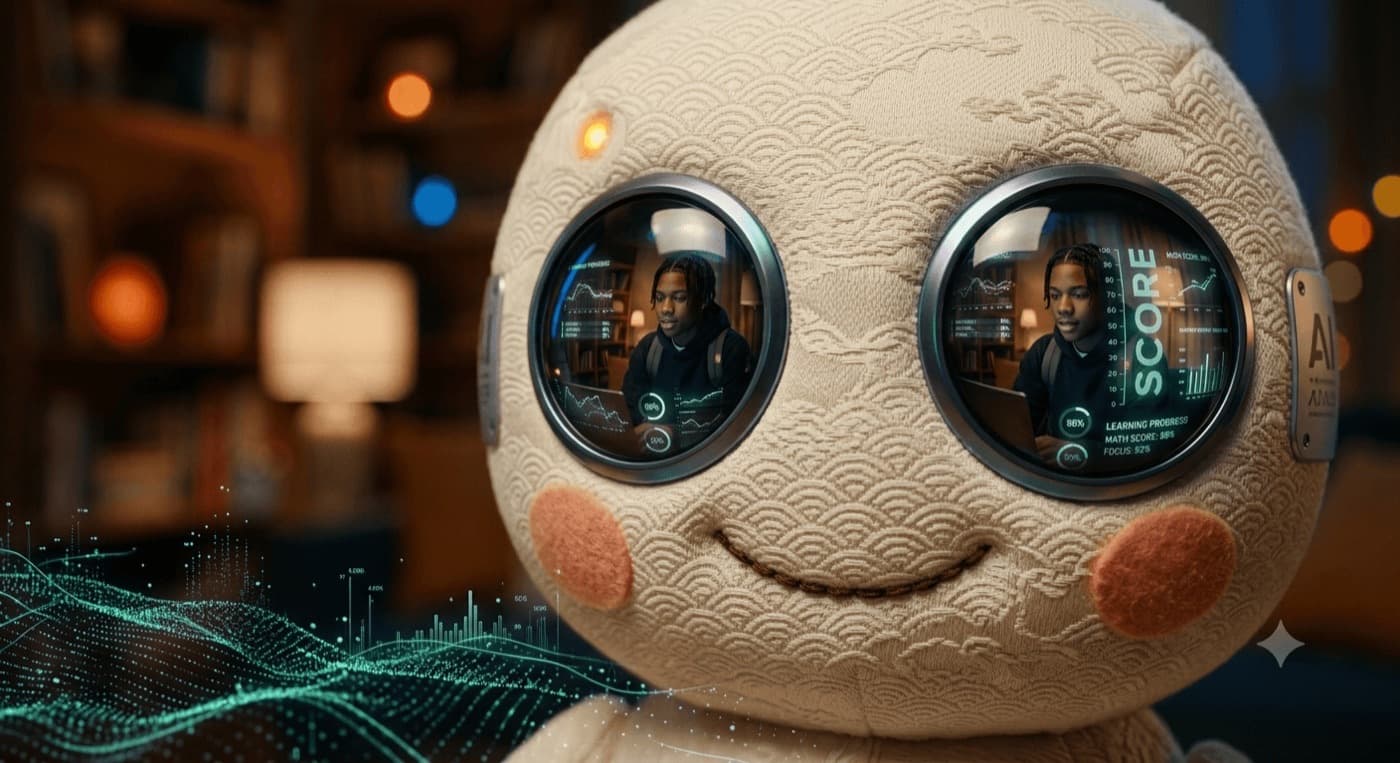
Picture a classroom two years from now. The child never sits for an exam, because the exam never stops. Her tutor is an AI that has watched her think across ten thousand small interactions, and it knows her the way no proctor ever could. It knows the half second she hesitates before a fraction. It knows which examples land and which slide off. Somewhere on a dashboard her mind is a multi-dimensional digital curve, updated by the hour. Nobody fills in a bubble anymore. The test moved into the tutor, and the tutor smiles.
This is not science fiction. This spring the International Baccalaureate began moving its exams onto screens, and every testing company is walking the same road. It may start with cameras watching students work a traditional exam, but eventually the timed sitting falls out of fashion. The pitch is seductive and, on its own terms, correct. Why trap a child's future in one bad Tuesday when a machine can assess her gently and forever, folding the measurement into the teaching so smoothly she never feels it?
The one-shot exam was cruel. The always-on exam is kind. It adapts. It personalizes. It knows.
Maya and Oliver
Take Maya. She is brilliant, and her artificial tutor knows it. She clears the module in twenty minutes, all green. The system gives her its one reward, which is more: more modules, higher levels, faster. By spring she is two grade levels ahead and everyone is proud.
And she has never made a single thing. She has never revised a sentence she was sick of, never spent a week stuck on a problem that would not move. The machine graded her straight past all of that, because it has to. A machine measures cleanly only what resolves cleanly — right or wrong, green or red. High contrast makes good data. Nuance is noise, and noise gets trimmed. Limit conditions are a source of error for an AI that puts everything into neat conceptual boxes. But when these are human beings, a limit condition is a child who is simply different from the others. It is time to celebrate our most human outliers, not hide them.
Across the park, at a school that costs sixty thousand dollars a year, Oliver passed the same content in September. Nobody cheered, because there, passing the test is not the finish line. No one cares about performing for an AI, unless it can help improve their actual performance — on a stage, with a real audience. An audience of bots doesn't work.
Working with an AI tutor is the opening gate for Oliver. He crams through that part as fast as he can to reach the more independent and thoughtful project work he much prefers. After the tutor cleared him for this most recent unit, Oliver spent five weeks on one project and rebuilt it three times. He wanted to quit one evening after school, and his teacher said no, then called his parents so the no would hold at home too. In May he defends the work before a panel of strangers, and partway through he offers an insight even the professional judges hadn't considered. Now they are the ones learning something. I wrote about that moment in my last essay.
Maya will never have such an audience. Her tutor congratulates. Her tutor promotes. It will never call humans into a room to watch her defend something she made. Struggle is the very thing her tutor was trained to eliminate. But productive struggle is all that really matters in education. AI walked Maya down the shortest path to graduation. It cannot imagine why anyone would want the long way.
The gate is not the destination
People assume the portfolio school is the one that went soft. Look again. Both children crammed the content. Only one was allowed to stop there.
The portfolio school treats the test as a gate, and that order is not an accident of privilege. It is what learning science has prescribed for decades: master the content first, so the mind is free to build with it, which is when ideas actually have a chance to stick. The gate opens onto the harder work — weeks of productive struggle, revision after revision, the very cycles in which neuroscience tells us learning actually consolidates — and at the end a defense in a room where nobody is required to be kind.
The cheap system treats the gate as the destination. Walk through it and there is nothing on the other side but a concrete wall.
Perfecting industrialized assessment is still industrialized assessment. The direction is top down. It is still one-way. It still has no room for ambiguity or nuance, because those refuse to resolve into anything a machine can score. Standardized testing has always worked by reduction, shrinking the complexity of a mind down to what can be marked right or wrong. The computer did not fix that. It made the reduction continuous.
Ask anyone who studies whether an assessment is valid: real evidence lives in the product a student makes, the process behind it, the performance in a live room, and the practice sustained over time. An endless test captures a sliver of the first and none of the rest. It sees the consumer in every child and is blind to the creator.
What the machine does when it does not know
The machine hates mess. It treats the child like another machine and fails the child as soon as that model breaks down. Watch what it does when it does not know something: it does not pause, does not sit in the discomfort, does not say wait. It makes something up, fluently and confidently — anything but ambiguity, even if a child is hurt by the lies it perpetuates about her.
In the old Pygmalion experiments, teachers were told that certain students, chosen at random, were about to bloom, and by the end of the year those students had. A teacher's belief becomes a child's ceiling, or her sky. Expectation is not a commentary on a child. It is a force acting on one.
So look again at that dashboard, quietly telling every adult in the building, with machine precision, exactly what each child is. And we know where hardened judgments lead, because we have measured that too: students pushed through the strictest, most punitive schools are arrested more, incarcerated more, and graduate less. That pipeline was built by hand, out of suspensions and nervous hunches. Feed it a continuous machine verdict on who is behind, who is disengaged, who is a risk, and you do not need a dystopian imagination. You need a spreadsheet.
Sometimes the wall behind the gate is a prison's. A system that decides early what a child is, and rarely lets her become otherwise, is not efficiency. It is malpractice with a dashboard. How can we propose to put such a system in charge of children learning the one skill it cannot perform — staying inside the not-knowing until something true comes out.
A tutor that cannot struggle cannot teach struggle.
Cheap is what gets procured for everyone else's children
A continuous automated test is cheap, and cheap is what gets procured for everyone else's children. I mapped this fork in The K-Shaped Classroom: one arm climbing toward creation, the other sliding toward compliance. AI is accelerating the underlying trend. A robot exam is the bottom arm sold as a gift.
And the stakes are bigger than any one child's transcript, because schooling at scale produces citizens at scale. One arm trains a child to direct her own attention, at work she chooses and builds, and graduates young people who can question an answer with an argument and evidence. The other trains her to surrender it to whatever the screen serves next, and graduates a community that thinks only what it is told, dependent on AI for everything.
A young person who commands her own attention is hard to manipulate. A generation that cannot, is easy to govern. That was the founding dream of the factory school. Fichte wanted children fashioned so thoroughly they could never will otherwise than their schoolmasters wished, and he kept the gradebook. A perfect test is his gradebook, automated at last.
It has already started
If the bottom arm sounds hypothetical, it has already started, in Los Angeles. In the spring of 2024 the nation's second largest district paid a startup roughly three million dollars for a friendly AI assistant named Ed, one warm front door to every child's records. Ed launched in March. By June the company had collapsed, most of its staff was gone, and one of its own engineers had already warned the district that student data was not being handled with basic privacy protections. When it ended, no one could say with confidence where the children's data had gone.
You pour a child's most intimate learning record into a system built to be inexpensive, and one quarter later the system is smoke and the data is gone — out of the parents' reach and, in breaches like this one, offered for sale.
In that same city, a parent said their child came home from kindergarten singing the first songs he had learned at school. They were Grammarly ads.
Point it at real work
None of this is an argument against the machine. AI, as I keep saying, is an amplifier, and it amplifies whatever we point it at. Point it at test prep and you get a test that never ends. Point it at real work and something remarkable comes within reach: the same technology that runs a perpetual exam for the masses can walk one public school student through content mastery and beyond.
Everything the sixty-thousand-dollar school buys, the struggle included, becomes buildable for every child only when content is a first step rather than an end goal of learning. And we know it works, because New York has been running the experiment for decades. Graduates of its performance assessment schools go to college and stay there at higher rates than their tested peers.
That is the choice, and it is closer than the comfortable timelines admit. We can let the machine measure our children more precisely than any generation in history while asking less of them than any generation before. Or we can make it hold the gate and then demand the harder thing on the far side, from every child, in every zip code.
A perfect test is still a test. It is where learning begins. It must never again be where learning ends.
First pass the test. Then make something the world has never seen, and publish it to a real audience: college admissions officers, family, and friends.