

The K-Shaped Classroom
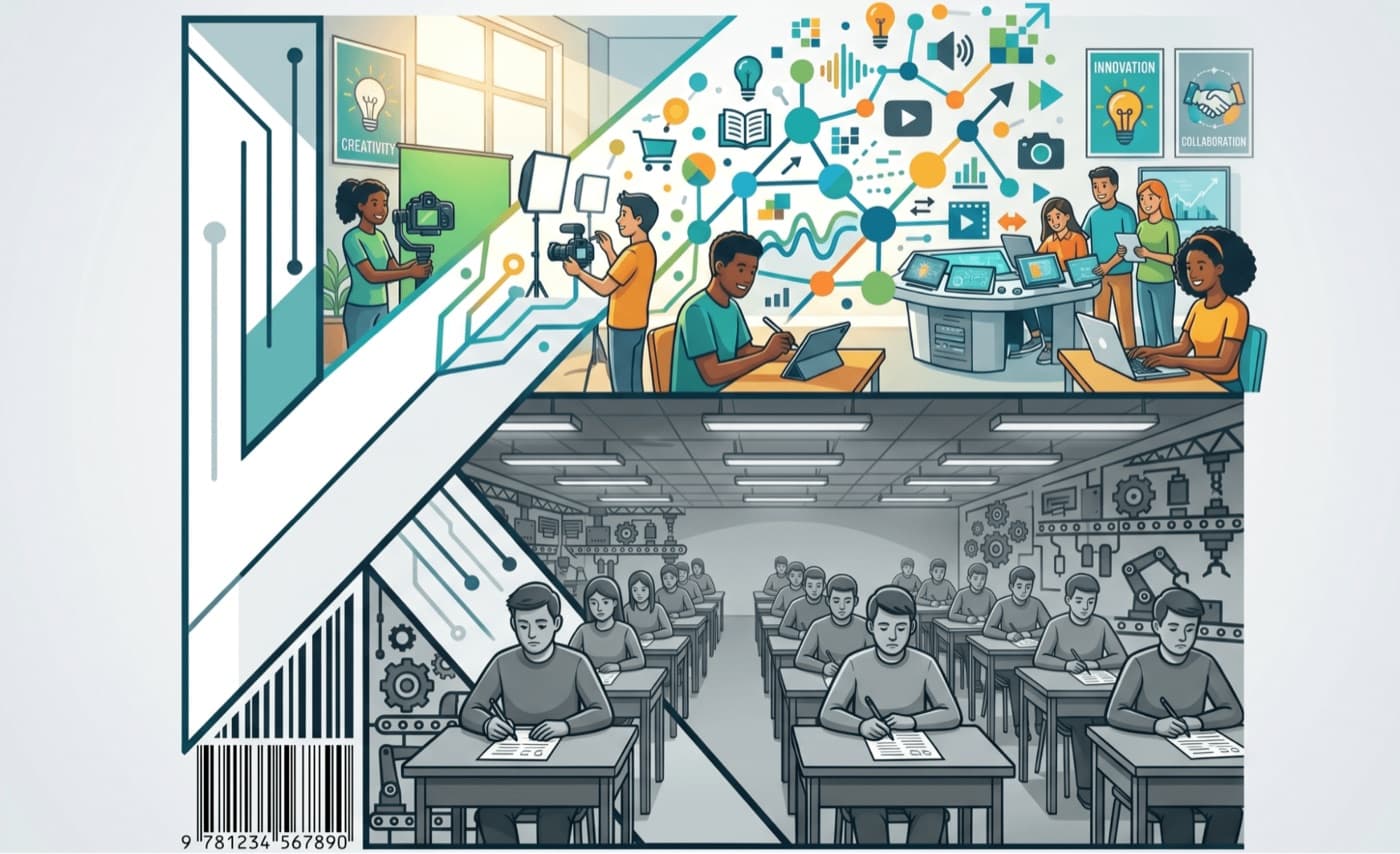
The K-shaped economy has become familiar shorthand for the inequality of our time. The top tier of earners climbs. The bottom tier falls. The middle hollows out. What no one has drawn yet is the K-shaped classroom, which portends an acceleration of everything the K-shaped economy has already set in motion. It is already here. But if the people running American education do not act now, a generation of young people will be left unprepared for the world that awaits them.
When Horace Mann toured Prussian schools in the 1840s and came home inspired by JG Fichte, he did not bring back a vision of intellectual liberation. He brought back a system — bells, batches, compliance, and a graduated march toward productive citizenship in an industrial economy. The students who graduated from those schools were not expected to invent the factory. They were expected to show up to it on time.
That system is still intact. Bell schedules control movement. Carnegie units measure learning as "seat time" like a punch clock. Standardized tests standardize thinking like they standardized machine parts. These were the instruments of an economy that needed interchangeable labor. They remain the instruments we use to measure learning, even though the economy they were designed to serve was outsourced to emerging economies who are now automating those jobs with actual robot workers.
Create or be consumed
The digital economy does not need compliant workers. It needs creators. Every major platform runs on the same engine: a small number of people produce original content, and a large number of people consume it. The producers capture attention and accumulate value. The consumers have their attention monetized by advertisers as they scroll. YouTube, TikTok, Substack — the architecture is identical across all of them.
Create or be consumed. Education is splitting right now along exactly this line.
In schools that serve education-focused families — private schools, well-funded suburban districts, consortium schools already producing portfolios — students do not spend their days drilling for tests. They design experiments. They build arguments. They produce work that goes into the world. Imagine the junior whose capstone project is presented before a real audience. Such students are not just learning content. They are learning to apply what they studied for the test to answer questions no one handed them, and to defend their thinking publicly. The assessment demands it, so the whole learning environment bends toward the creation of quality academic work for a real audience.
In schools that serve everyone else, the story is different. These students sit in factory-style rows, working through textbook content and test prep curricula. The edtech revolution, which was supposed to close the gap, has largely widened it. Adaptive learning platforms deliver content efficiently and test it mechanically, running on the same feed architecture as the social media waiting outside the classroom door to monetize students' attention. They are well-designed to perfect the testing-heavy industrial model — to arrive at a better version of online adaptive testing and AI tutoring. But it's more of the wrong kind of "teach-to-the-test" learning.
Harvard assessment researcher Daniel Koretz spent decades documenting what such testing does to classrooms. His conclusion was unsparing: high-stakes testing had become "an end in itself, harming students and corrupting the very ideals of teaching."
Content is delivered. Content is tested. The bell rings. No one asks students to travel past that content — toward application, toward the questions that only they, with their particular history and culture, are positioned to ask.
Culture is the engine, not the supplement
Consider the entire industry of culturally responsive teacher training. It would not exist if students were simply asked to take what they had learned on a test and apply it to their own world. That act of application is where each student brings something irreplaceable: their own culture, their own experience, their own way of seeing.
Culture is not a supplement to rigorous academics. It is the engine of original thought. Inter-generational transmission of knowledge has sustained humanity since we learned oral traditions thousands of years ago. The wisdom of our grandparents is being forgotten. A system that measures only recall has no room for having students ask for grandma's advice on a school project. You can't get more culturally responsive than including grandma's voice in classroom learning. We only have to add back in "culturally responsive" practice when we are working on a substrate of standardized learning.
The National Education Association and FairTest have documented that rigorous performance-based assessment — the kind that asks students to do something original — remains largely inaccessible to students outside privileged institutions. We know what works. Students assessed on their ability to produce real academic work persist in college at higher rates, earn more credits in their first semester, and demonstrate stronger academic preparation than peers assessed through standardized tests — even peers who scored higher on the SAT. The Learning Policy Institute confirmed this in a landmark study of CUNY admissions: portfolio assessment predicted college success. Test scores did not.
And yet none of it has changed what happens in most classrooms. Assessment drives pedagogy. What gets measured gets taught. In most public schools, what gets measured can still fit on an answer key — because testing is cheap, familiar, and easy to defend at a school board meeting. So students answer practice questions at the back of the chapter, and call it learning when they should be the ones asking the questions in the first place.
AI will steepen the K
Artificial intelligence will not solve this problem. It will accelerate it.
The student who has been trained to produce original work will use AI the way a craftsman uses a power tool — to amplify something she could already do. She will research more deeply, draft more quickly, revise more precisely, and build something more remarkable than she could have done alone. She will remain a producer. The product will reflect her unique cultural perspective.
Unlike the student whose entire academic experience has asked only that he recall and repeat. He will use AI to offload the thinking he was never asked to do himself. He will become a more efficient scroller, even in the classroom as he flips through his content feed provided by an online assessment.
The K-shape will steepen.
An assessment problem, not a technology problem
This is not a technology problem. It is not even a funding problem. It is an assessment problem.
New York State has begun to understand this. The July 2025 adoption of the Portrait of a Graduate framework and the phased elimination of Regents examinations as the only measure for graduation by 2027–28 is a real acknowledgment that the old measuring stick is broken. It is a significant step. But adopting a new philosophy of graduation without building the infrastructure to measure what matters is a promise without a delivery system.
Declaring that students should think critically and communicate powerfully means nothing if the only instrument available to verify it is still a content-focused exam. The question is whether students can produce original work and defend it, academically, and in public.
The fork is already in the road. Some students will learn to produce. Others will learn to scroll fancy new digital textbooks. The divide will outlast every student living it today. What policymakers decide to measure will determine which side of the K their students spend their lives on.
One thing you can do today: support youth journalism in any form. If you are looking for a place to start, the Academic Capital Foundation has established a fund to help students get original work published before a university audience. Every donation puts a student on the producing side of the divide.
Nadav Zeimer is a former NYC turnaround principal.
#PassionForLearning #AcademicCapital #ListenToTheYouth