

The Treadmill Will Save Humanity from AI
Around 1818 the treadmill was invented to punish prisoners. Today we pay by the month to use one. What happened in between has already happened to our food, and it is about to happen to thinking.
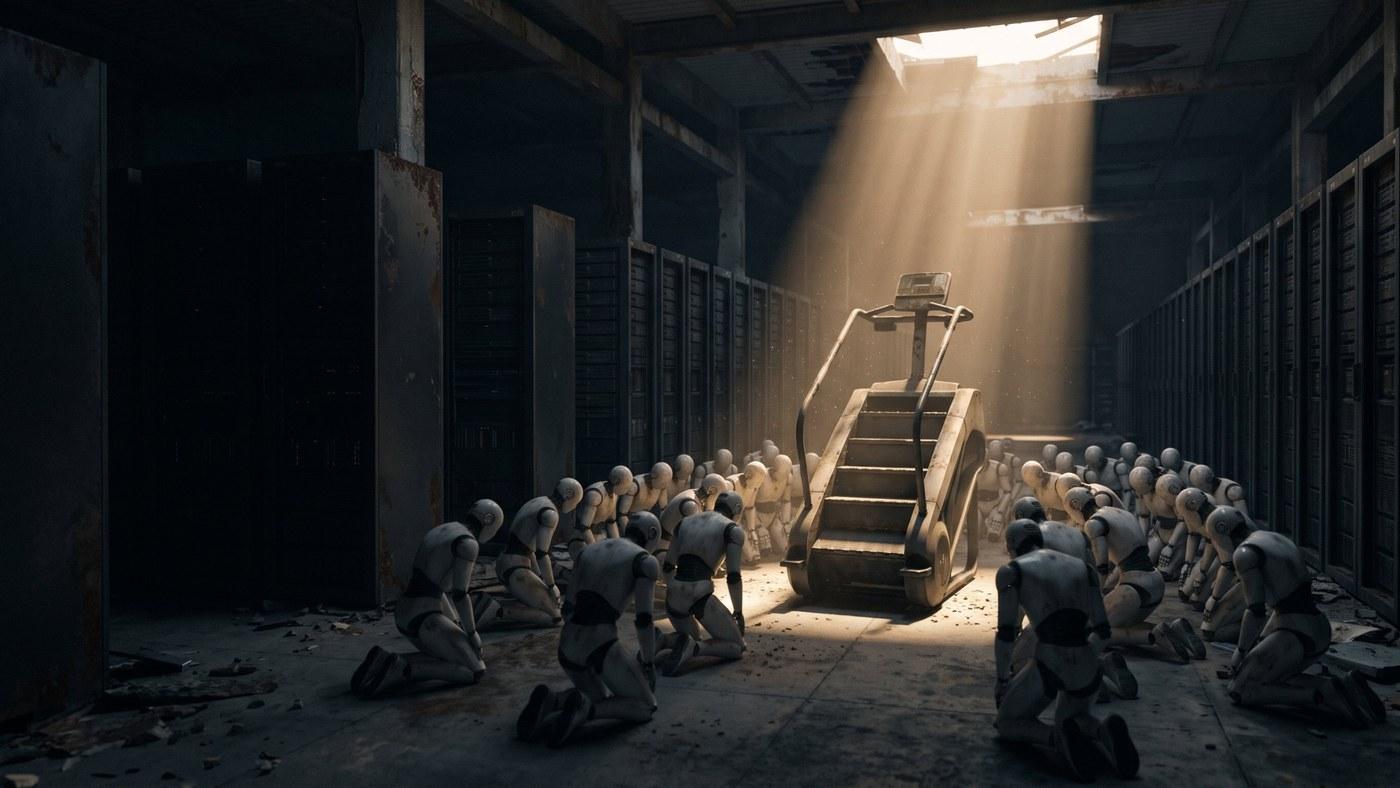
The first treadmill was a staircase that never arrived anywhere. An English engineer named William Cubitt built it for a county jail around 1818: a wide wheel with steps set into it, turned by the feet of prisoners climbing side by side for hours a day. Some of the wheels ground grain. In time most of them ground nothing, and the climbing was the whole punishment. By 1824 more than fifty British prisons had one.
Nobody in 1818 needed more climbing. A day was already made of walking, hauling, and lifting. We had been handing that work off since the first farm, to the ox and the plow and the mill, and in the two centuries after Cubitt the engine took nearly all of it. The gift was real. It also left our bodies with so little to do that people now pay by the month to walk on a machine with the same name.
It keeps happening. A tool takes a hardship off our hands, and some years later it hands the same thing back as a choice. The difference is who does the deciding. A farmhand in 1818 never had to decide to spend the day walking and lifting. The job decided, because it was the only way to eat. Today the walking happens only if I decide to do it, and deciding a single time settles nothing. The treadmill is there again tomorrow, and nobody will make me get on. A hardship is decided for me. A choice has to be made by me, again every morning. That is the challenge in front of human society today: how to take on enough struggle to stay healthy when no hardship forces it on us. That is true for the mind as much as for the body.
In 1900 four in ten American workers farmed. By 2000 it was fewer than two in a hundred, feeding far more people. Hunger, our oldest hardship, left many kitchen tables, and what came back was a choice of what and how much to eat. The idea of junk food would have sounded crazy to our ancestors, who faced scarcity. Today we drown in it. In 2023 nearly six of every ten dollars Americans spent on food bought food someone else had prepared, the most on record. We have been offloading our abilities to technology for all of human history.
A mouthful of bread used to be the last step of a long chain. Someone plowed, planted, weeded, cut, threshed, and ground. Someone hauled wood and water and stood at the fire. Each step waited on the one before it, and on the weather, and somebody had to be there for all of it, so it took a community. A donut asks none of that.
For most of history the hard part was getting food into a mouth. Now every step that used to stand between a person and a bite is gone, and the discipline is to keep food out of my mouth. Many of us are drowning in food, the way we are drowning in too much media and information. The hunter of old had to find something to eat. The hunter of today has to move through all of it, take only what is good for them, and leave the slop alone, even when the slop is designed to trigger deep human desires. Slop, scams, fake news, and conspiracy theories are all junk food.
I am still learning to hunt in reverse, to stay healthy in this ocean of processed goodness. I have met more than one donut at the last bite. And that is only since eight this morning. The first bites happen without me: a hand goes out, the donut gets eaten, and I arrive for the final mouthful wondering who approved this. The old chain took effort, and the effort kept people from starving to death. A donut has nothing to do with starving and everything to do with eating ourselves to death. A brief lapse of awareness is all an impulse needs. So the choice gets made without me, the way I do not choose whether it rains. The donut happens to me, passively, whenever a colleague buys a box and shoves it in front of me.
Every choice a tool hands back has that catch: it is mine only when I am there for it. When I am not, it backfires, and I get used. Having many food options is a blessing, unless we forget to hunt in reverse. Then we get obese on junk we do not notice we are eating. I am so lost in my head that my body acts without me, on instincts built for a time when food was hard to find. We lived in our bodies when we had to. Now it is optional.
Now a machine does the head's work, too. A chatbot is built from what experts have written down, and most of what I was trained to do from the neck up, it does in seconds. An answer now arrives the way the donut does: finished, in my hand, with every step that used to come before it gone. Figuring things out has become optional, which means it is on its way back to each of us as a choice. Do we get on the cognitive treadmill to keep our faculties sharp, or do we scroll social media mindlessly instead?
I saw what that looks like at a party full of software engineers. Their director, who does not use AI yet (shocking, I know), had found signs in the team's shared code that one colleague was turning in work written by an AI assistant. Everyone on the team said they use AI too, for the tedious parts: looking things up, cleaning things up, keeping things in order. But they all review what AI writes and find ways to improve it. None of them turns in the code it writes without review. The exception was that colleague, who was not there. It appeared he did not even review much of what he submitted, and it had cost him the respect of the team.
The other team members stay in shape mentally. They do their own figuring and send the machine on errands, and it can carry them ten times further than they would get alone. But his code went out the way my donut goes down: without him. If AI went away tomorrow, the team would slow down and keep working, doing the tedious bits themselves again. According to them, that one colleague would stop, because he was forgetting how to code. It goes fast, too. In experiments with 1,222 people, ten or fifteen minutes with an AI helper on math and reading problems was enough. Once the helper was gone, they gave up more often than people who never had one.
One room, one technology, two outcomes, decided one person at a time. I am hopeful, because that loss of respect shows we still value hard work. But I know how hard it is to keep getting on the treadmill, and how easy it is to blame circumstances and indulge. We think scrolling will rejuvenate us when we are exhausted. It prevents further loss of energy, but energy comes back only when we want something and get it.
When people ask whether AI will save humanity or end it, I think of the tractor. It fed us, and left each of us alone with Uber Eats and Dunkin', to fend for ourselves. We will get obese and stupid if we do not discover how good it feels to exercise our bodies and our minds. Soon the robots will join the chatbots, and we will have to choose how to live and what to do with our idle hands and hearts.
A job trades time for money. Work makes something of value, paid or not: a meal, a garden, a parent cared for, code a colleague can trust. Self-esteem, satisfaction, and rejuvenation come from the work. The lucky ones get paid for it too. The robots will take jobs the way the engine took the walking, and the work will come back to each of us as a choice. In the last chapter of Voltaire's Candide, an old man who farms twenty acres with his children says work keeps away three great evils: boredom, vice, and need. The tractor took need off many kitchen tables. Boredom and vice are left for us to navigate.
And nobody can make the choice for anyone else. The only time the law put people on a treadmill, it was to punish them. A law can keep a machine out of a second grader's hands. It cannot make anyone want to do the hard work required to stay healthy. I cannot force it on myself either. Willpower is my head yelling at my hand, but my hand does not report to my head.
What the choice takes is wanting something. A chatbot has an answer for everything and an appetite for nothing. It has never been hungry. The wanting is mine, and when I go looking for it I find it lower down than my head. My hands report to the belly and the heart, which is how they can feed me a donut while my head says no.
I cannot remember ever thinking my way into wanting something. So for twenty minutes a day I let my attention slip out of my head and down into my belly. Sitting with nothing to do used to come free with the day. Now I set a timer for it. It is my treadmill. It has to be done. After enough of it I can find my belly quickly, in the middle of a day, and ask it something before my hand moves. Am I hungry? What do I want here? How do I feel? It is a gut check, in the plainest sense of the words. And it tells me what I want, which is not always what my hand is reaching for.
Anyone can try one today, and it takes about ten seconds. Before the next question typed into a chatbot, let your attention sink from your head to your belly and ask what you want. Wanting is what makes a tool worth having. I was a slow reader until I had a book of my own to write. Then I went through 400 pages in two days, because I wanted something from them. The wanting came first and the speed followed. Discipline has come to me the same way. Those books became useful the day I had a use for them, and a chatbot is the same.
I grew up in a school built to educate through the hands and the heart alongside the head. Then I taught in, and later ran, schools built to grade the head. The climb is assigned, and what gets graded is what a head can hold long enough to answer on a test. A school teaches what it grades. So a student who has only ever climbed because it was assigned meets a machine that will do the climbing. The answer is to make the climb matter to the hands and the heart too. A chatbot can help a student make something. It cannot do the wanting, the caring, the motivating. That kind of work is what we built HScred for, because all of education lives downstream of what we choose to grade. So let us grade the wanting, along with the reading and the writing.
The treadmill started as a punishment and became a choice. Everything hard is about to make the same trip: the walking, the cooking, the writing, the figuring out. Technology will keep bringing abundance, and the question that remains is what each of us does with all the options it leaves behind. Nobody is going to put us on the treadmill this time. We get on because we want something, and those choices, added up one person at a time, decide whether the abundance turns out to be a gift. If enough of us choose to get on, we may learn to use AI for our benefit rather than our demise. Humanity is more than eight billion people, and I can put exactly one of them on the treadmill. One piece of humanity is within my reach, and at the moment it is holding a donut.
Nadav Zeimer is a former NYC turnaround principal and the founder of HScred, Inc.
#PassionForLearning #AcademicCapital #AuthenticLearning #ListenToTheYouth