

NYC's Path Beyond Standardized Testing May Surprise You
Assessment reform is education reform. Not curriculum. Not standards. How we measure whether students have learned drives everything else.
New York has known this since 1864, when the Board of Regents launched America's first uniform state exams. Now the state is about to leap again. In July 2025 the Board of Regents adopted a Portrait of a Graduate as the cornerstone of how it will define a diploma. The surprising part is who is already implementing it: a barely funded, little-known coalition of students and teachers.
While districts across America debate what might replace the test, New York City already has something that works. It is called Journalism for All, a free year-long curriculum out of CUNY's Newmark journalism school, now running in thirty public high schools. I recently interviewed one of its architects, Katina Paron.
What happened on the steps of City Hall
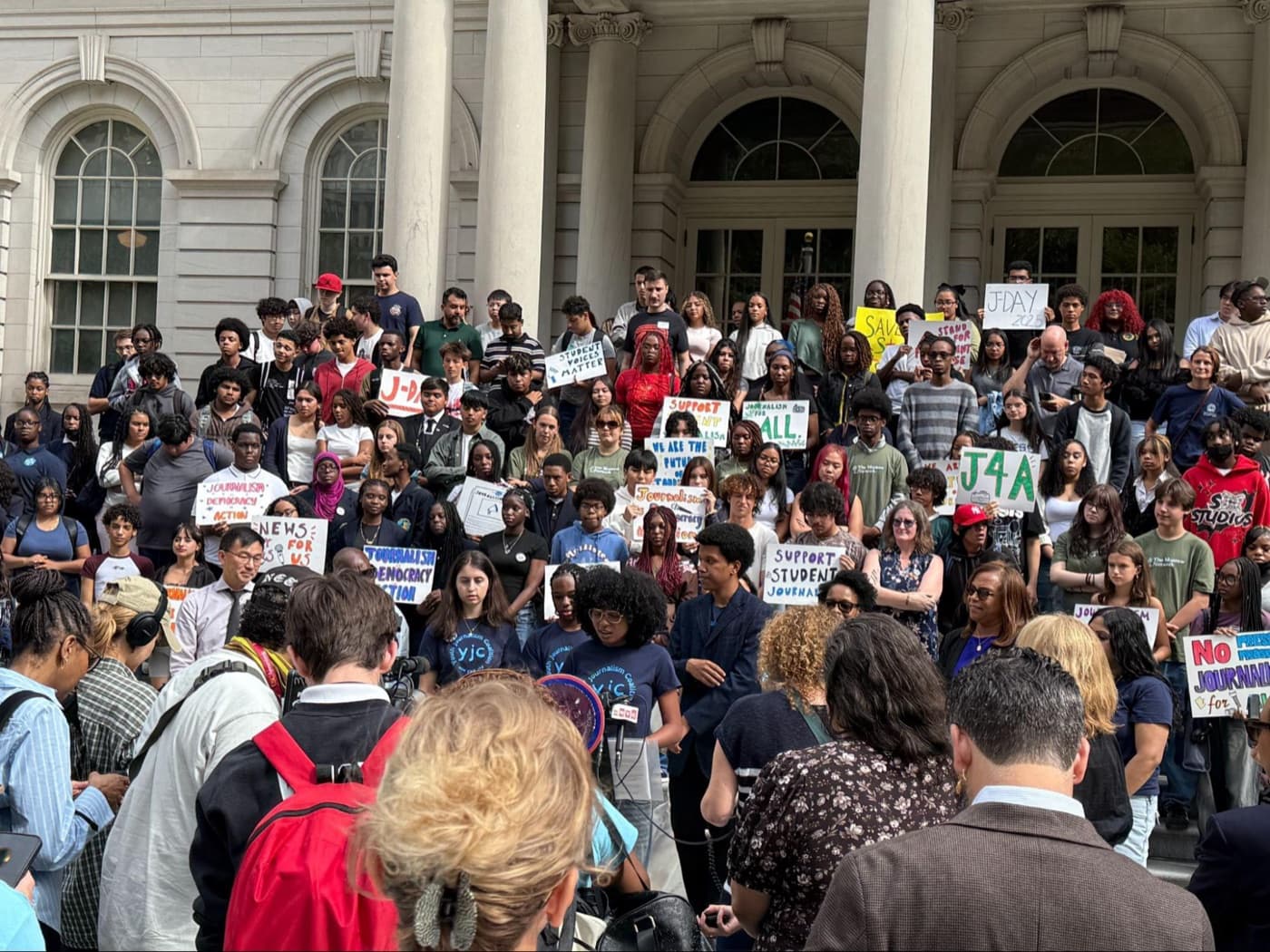
Step back to September. On the sixteenth, more than two hundred students and teachers gathered on the steps of City Hall for J-Day, the second annual day of action led by the NYC Youth Journalism Coalition. They were not thinking about the Portrait of a Graduate. Their wins were about journalism. The city's schools superintendent stood up and called for every young person in New York to have the chance to do it. The coalition marked thirty new journalism courses across the city.
And because of Local Law 27, which the coalition championed, the Department of Education had just released the first hard count of who actually has access. The number is the argument. Only about one percent of the city's high schoolers, in ninety of roughly four hundred schools, had a journalism course at all.
What made the day matter was not the policy. It was watching students take the microphone and step into the power of that setting, with council members and university leaders standing behind them, all of it organized around a form of learning that implements the Portrait of a Graduate out of the box — and not just in journalism.
The path forward is no longer theoretical. It is happening first in a classroom run as a newsroom. That provides a working model of what classwork looks like after the standardized test is gone.
The newsroom does not approximate the Portrait. It is the Portrait.
The Portrait asks for graduates who think critically, communicate clearly, collaborate, act with cultural and civic awareness, and apply learning across contexts. Look at what reporting demands. Inquiry and analysis to find the story. Clear communication to write it for an audience using sound sources and low-inference evidence. Collaboration to make deadline with editors and peers. Civic readiness and humility to face the people you cover. The newsroom does not approximate the Portrait. It is the Portrait, already running in city classrooms.
Other project-based learning is ahead of the curve, too, because those classrooms had previously stepped back from teaching to a test. All of STEAM can be included in such early-adopter classrooms.
What sets journalism apart is that it arms students with the skills to create portfolio artifacts in every other content area. Academic media digitizes, and digital work is what finally lets evaluation scale. A ten-minute student recording — reported and revised and published — is the unit that can replace the bubble sheet. It is strengths-based. There are no failing grades, only stories not yet published. I have written more about that idea in Academic Capital.
The journalism team is the implementation unit
The coalition is not theorizing about alternatives to the test. It is practicing them. Student reporters are producing real work for real audiences and building portfolios that show exactly the competencies the Portrait names.
Expanding journalism is the fastest first step to implement it. A school's journalism team is its implementation unit. Then the reporting spreads. Students cover the science lab, publish the essay, run down the budget story. The work goes to an audience instead of into a teacher's drawer, never to be seen again. Once a student can research, interview, draft, and edit for one class, every other teacher can call on the same skill.
A student investigating climate change makes a ten-minute video explaining the science. Another builds a podcast that breaks down a hard piece of mathematics. Journalism teaches the craft of making thinking clear and public, and once a student owns that craft, every subject becomes a chance to show what they know and how they think.
These are not just journalism programs. They are academic media centers — the place a school sends a student to turn what they learned into something worth publishing. That matters most in the eleventh and twelfth grades, when colleges are trying to meet them.
What comes next, in one sentence
The national conversation about life after the standardized test keeps stalling because people cannot picture what comes next. This is what comes next. A student investigates a real issue, interviews sources, meets an editor's standard, and publishes for the public. That single project shows mastery across several subjects at once, and the work is its own assessment. This is what performance-based assessment means in practice.
Other cities and states are still searching for a model. New York City has one that works, that scales, and that students actually want to do. Now the city just has to fund it.
The Regents timeline phases the test out as a graduation requirement by 2028. New York City does not have to invent what replaces it. It can recognize and fund what is already working. Start with journalism, find the other project-based work worth showcasing, and the Portrait becomes a future you can actually reach.
Journalism for All carries the same ambition as AP for All, the city's last great access push, except that instead of widening access to a test it widens access to authentic, performance-based work. The Consortium schools and the transfer schools have done this for years. We have stories to tell, and the state is finally asking us to tell them.
The students on those City Hall steps in September already showed us what is possible. They were not performing for a test. They were demonstrating the very skills the city and the country keep saying they need. Mayor Mamdani took office in January with a mandate for exactly this kind of change and a proven pathway already running inside his own schools.
The question is no longer whether New York should pursue the Portrait of a Graduate through student work. It is whether we will recognize that student journalists have already shown us how to start, and whether we will have the nerve to build on what works.
Nadav Zeimer is a former NYC turnaround principal and the founder of HScred, Inc.
#PassionForLearning #AcademicCapital #ListenToTheYouth