Everyone thinks Michael Bloomberg got rich selling data. But do you actually know what his company, the one that made him a billionaire and then a mayor, even does? It is a data company and a media company at once, and then there is the part everyone skips, the part that matters most.
When Bloomberg started, a bond price was closer to a rumor than a fact. Bonds traded over the counter, by phone and by favor, and no two desks on Wall Street agreed on what a thing was worth. Stocks had tickers since the 1860s and screens since 1960, but the bigger, slower, richer market sat in the dark. Bloomberg dragged it into the light. His terminal did not just show you the number that had once lived on a slip of paper. It let you work the number, compare it, compute a yield, message the trader across the street, see in high resolution what a bond was actually worth. He made an opaque market legible, and then he charged for the view. What he had really built, underneath it all, was a gauge: an instrument that takes something messy and hidden and gives you a clean reading of what it is worth. Stack enough of them on one screen and you call it a terminal.
His company never owned the bonds. So why was it worth a fortune? Because Bloomberg owned the gauges everyone used to price them. Suddenly traders could see deals that had been hiding in plain sight. Today there are around 325,000 of his terminals in the world. The traders came and went. Banks blew up and were born again. The instrument panel outlived all of them. In any market, the durable power is not the asset. It is the trusted panel that makes the asset legible, and whoever builds it writes the terms of trade. That is the part everyone skips. Call Bloomberg a data company or a media company and you miss where the power actually sits: in owning the gauge everyone else is forced to read.
The terminal is only half the machine. That's the database. So why is Bloomberg also a newsroom? Because it lets him own the data and the narrative at once. He hired the most trusted names and had them report under the same banner as the numbers they were covering. The loop feeds itself: the reporters are trusted because they have the data, and the data is trusted because the reporters use it.
He started Bloomberg News in 1990, then added radio, television, and a magazine, thousands of journalists feeding one machine. The reporting was never the profit. The terminal was. But the reporting made the terminal worth having, and made the name itself mean something. The media exists to make the data trusted. The New York Times built a whole opinion podcast on the same promise: "you have heard the news, here is what to make of it." That is what a media arm does. It reads the gauges and tells you what they mean, because no one has time to read them all. Bloomberg was also one of the first digital-native companies, a private social network for traders decades before Facebook. The same instinct as Zuckerberg, pointed at a different room.
Once you see the pattern, you cannot stop seeing it. A credit score is a gauge, and the bureaus that own it sit astride every loan in the country without lending a dime. So is a search rank. So is a box-office tally, a Nielsen rating, a ratings agency's single letter, the number of stars on an Airbnb listing. None of them own the thing they measure. They own the measurement, which turns out to be the better thing to own. The scorekeeper outlives the players.
A pilot named Brian Robertson learned the other half of this the hard way. Alone in a small plane on his first long solo, one warning light came on, low voltage. Every other instrument looked fine, his airspeed, his altitude, his fuel, his heading, so he let the majority outvote the one gauge telling the truth. Hours later he was lost in a storm with no radio and no lights, nearly out of fuel, stumbling into controlled airspace near a major airport. He lived, and built a whole theory of organizations on the lesson: an institution is only as good as the instruments it trusts. You do not fly into the ground because the weather turned. You fly into the ground because you believed the wrong gauge.
Now think about the instruments a school uses to measure a student. Somewhere tonight there is a girl in a public school you will never hear of who is the most interesting mind in her building. She runs a podcast nobody assigned her. She taught herself organic chemistry out of a library book because her school does not offer the class. She built a robot from salvaged parts. And when she applies to college, almost none of it will fit in the boxes on the form. Her school offers no AP to prove the chemistry. Her grade point average sits in a stack of a thousand others that each mean something different. Her essay, the one place she might have spoken in her own voice, now reads like everyone else's, because a machine writes those for free. She is extraordinary. She is invisible. And the instrument that cannot show her is not cruel. It is blind. It has no sensor that can register her.
She is not rare. She is in every building in the country. Education is an information market, and it has always run on broken gauges, except these do not even disagree. They all point the same way, they all miss the same girl, and they are all wrong together. The SAT went optional at nine of every ten ranked colleges. For a while the essay was the last one anyone half-trusted, the only way to read a kid in rural Ohio against a kid in Queens, and then AI turned it to noise. More than half of American teenagers now run their schoolwork through a chatbot. Three years ago it was thirteen percent. The last gauge education had is gone, and it is not coming back.
When a market loses its gauge, it never reverts. It builds a new one. It is already happening. New York just voted to retire the Regents-exam diploma and replace it with one built on demonstrated work, the first time the state has moved off the exam in the 160 years since it gave the first one. The colleges are not fighting that. They are begging for it. The only open questions left are who builds the new instrument and what it is built to reward.
Here's the part worth stealing. When a field's gauge breaks, stop watching the incumbents and watch who builds the next one. Whoever does, writes the rules for the next twenty years, the way a bond trader's whole day is still shaped by a machine one man built in the eighties. It happened to finance, to credit, to attention. Education is next.
But a gauge is never neutral. It decides what counts, and what counts decides what gets taught, what gets funded, and who gets seen. Build education's new one to reward what money already buys, the private coach at three hundred dollars an hour, and you have laundered privilege through a new machine and called it merit. Build it to reward work a kid makes and defends in the open, and the girl with the podcast and the library-book chemistry is suddenly as legible as anyone in the country, because the work speaks and the work is hers.
That is one fork. Here is the other. Facebook and its children aimed their databases at advertisers and ran on our attention. Bloomberg aimed his at institutions and charged them for the truth. One model makes you the product. The other makes you the customer. Education's gauge will be built on one of the two, and the choice settles something before a single kid is measured: whether she is being served, or sold.
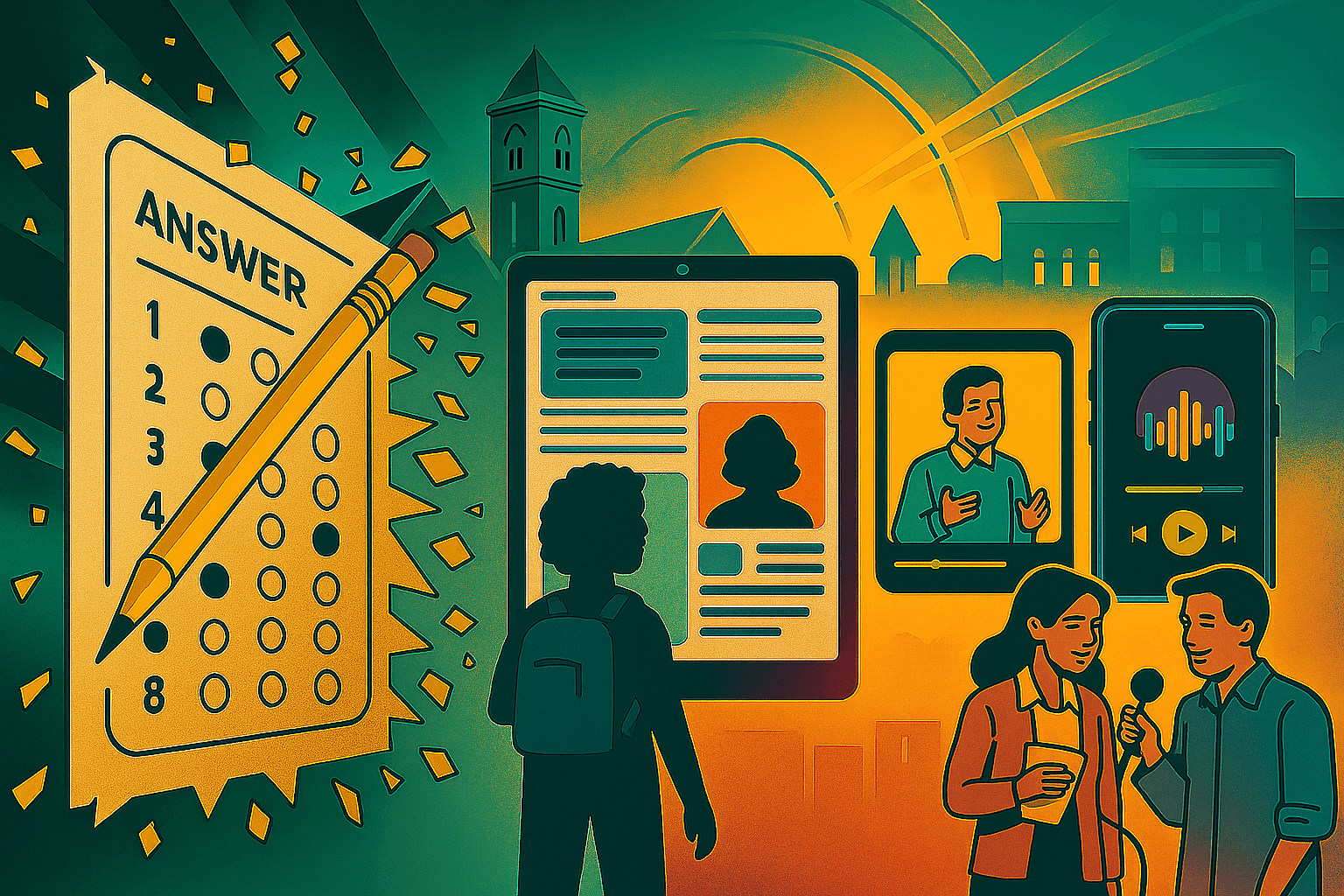
This is the company I am building, so discount me accordingly. It is built like Bloomberg, two things welded together. Students publish real work, that is the media. The work becomes a searchable, scored record, that is the data. The media makes the data, institutions pay to search it, and advertisers never get in the room. We measure the work, not the child. A test is handed down from above. It picks the questions, picks the day, and turns her into a number using its answer key. A gauge does the opposite. It reads what she already made, on her own terms. That is the difference between a test and a gauge. She does not sit and fill in our multiple-choice bubbles. She shows us what she actually thinks, stands behind it with evidence, and defends it on video, where three outside experts, not us, score it. We build the gauge. We do not get to be the judge.
Believe none of it on my say-so. Every founder swears his machine is the good one. Believe the pattern instead. Education's gauge broke. A new one gets built, whether by HSCred or by someone else. The only thing left to decide is whose values get cast into it.
I pass a front door, one over from my daughter's school. It's the home of the man who built the gauge for the bond market, and I used to wonder how he got so rich. I do not wonder that anymore. I wonder if I can build our Bloomberg, for academic achievement rather than bonds. And if we can finally celebrate all those kids in average high schools who are not at all average.
The talent was already there. The only question that has ever mattered is whether we build something that can finally recognize it.
Nadav Zeimer is a former NYC turnaround principal and the founder of HSCred, Inc.
#PassionForLearning #AcademicCapital #ListenToTheYouth

Now Boarding: The First Class

A Perfect Test

The Last Banker in Our Classrooms

Our AI Problem Is Older Than AI

The K-Shaped Classroom

Double Fall Line

Join Us on a Journey to Infinity & Beyond

The First Cohort

Into Open Water

Professors, Not Permissions

Organic Leadership: A Perfect Principal Is a Paralyzed Principal
City as Teacher, World as Audience

Sick and Tired of Being Tested

Inquiry Without Corruption

Powered by Students: Why HSCred Asks Not of Teachers nor Admissions Offices

How 'College Now' Paved the Way for Today's Assessment Revolution
NYC's Path Beyond Standardized Testing May Surprise You
PBA vs. CBA: The Right Way to Transform Assessment in New York

Election Day 2025: Shaping NYC's Educational Landscape

Two Julies in Albany

Bridging the Gap: What Japan’s Independent Study Model Teaches Us About College-Ready Inquiry
Standardized Tests Are Sunsetting: What's Next for College Admissions?

Academic Capital: The New Gold Standard of Student Achievement